
Contents (15)
- [Project Methodology] Application of Waterfall & Agile
- 1. Waterfall Model
- Key Concepts
- merit
- disadvantage
- 2. Agile
- Key Concepts
- merit
- disadvantage
- 3. Differences between Agile and Waterfall
- 4. Concerns I had thought about
- Q1. What if we go with a hybrid?
- Q2. What if I want to switch from Waterfall to Agile?
- Q3. If you want to check whether our organization is closer to Agile or Waterfall?
- 5. Conclusion
[Project Methodology] Application of Waterfall & Agile
When starting a project, do you choose between the Waterfall model and the Agile model as your main project management method?
I don't think I have been selecting the appropriate method so far by considering the current situation, developed features, or team members' skill levels. I simply tried to work in an Agile manner because it was widely used, but in reality, I have been working using the Waterfall model... So, I am writing this post to organize my thoughts on Waterfall and Agile.
One of the first things you must decide when starting a project is the methodology. When I was a newcomer, I used to think, "Of course Agile is better because it offers faster feedback and flexibility," but I’ve since realized that there is no inherently better or worse. You need to be able to use each model appropriately depending on the situation. In this article, I intend to introduce the implementation methods and differences between the two methodologies.
1. Waterfall Model
Key Concepts
As the name suggests, the waterfall model proceeds sequentially through stages, just like water flowing from top to bottom .
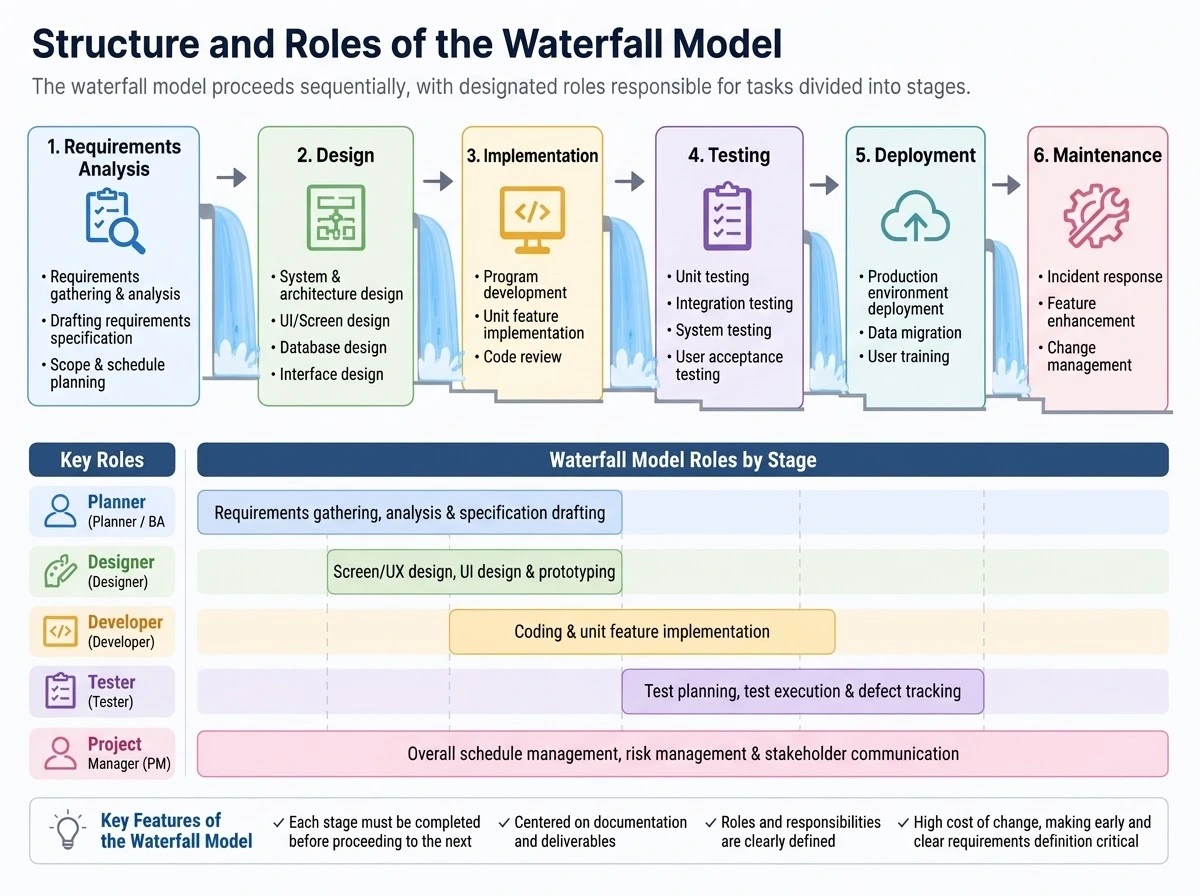
You must complete each step to move on to the next, and in principle, returning to a previous step is difficult or costly.
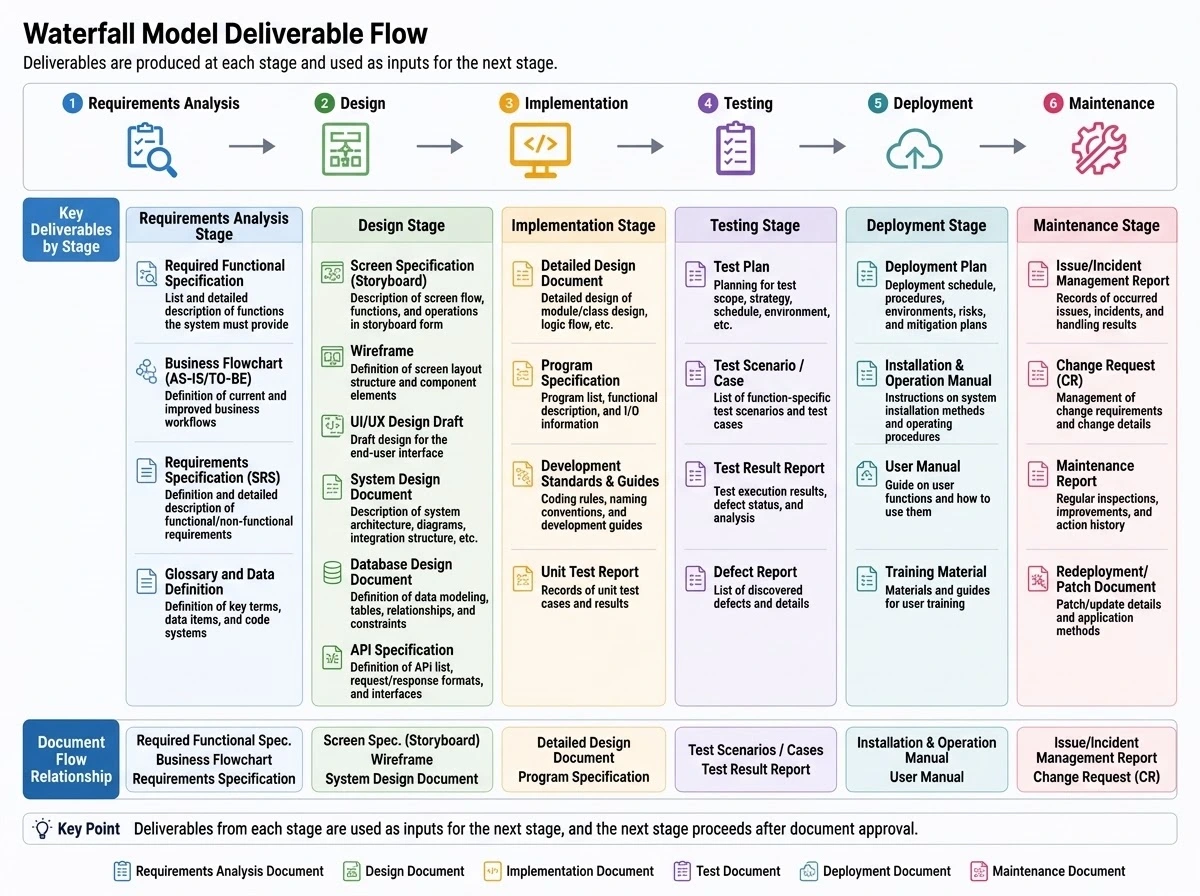
And there are a lot of documents produced as well. That means the product is released with a solid design.
merit
The schedule and cost forecast are clear.
The handover is relatively easy because there is plenty of documentation.
It is efficient in projects with fixed requirements.
disadvantage
It is vulnerable to changes. If requirements change after the design phase, it is impossible to know how the schedule and costs will change.
The user sees the results late.
There is a heavy burden to perfectly define all requirements in the initial stages, and realistically, perfection is difficult to achieve.
2. Agile
Key Concepts
Agile is a set of philosophies and principles rather than a methodology. It typically involves creating working deliverables in short cycles (usually 1-4 weeks, called 'sprints') and improving them based on feedback.
Representative frameworks include Scrum and Kanban .
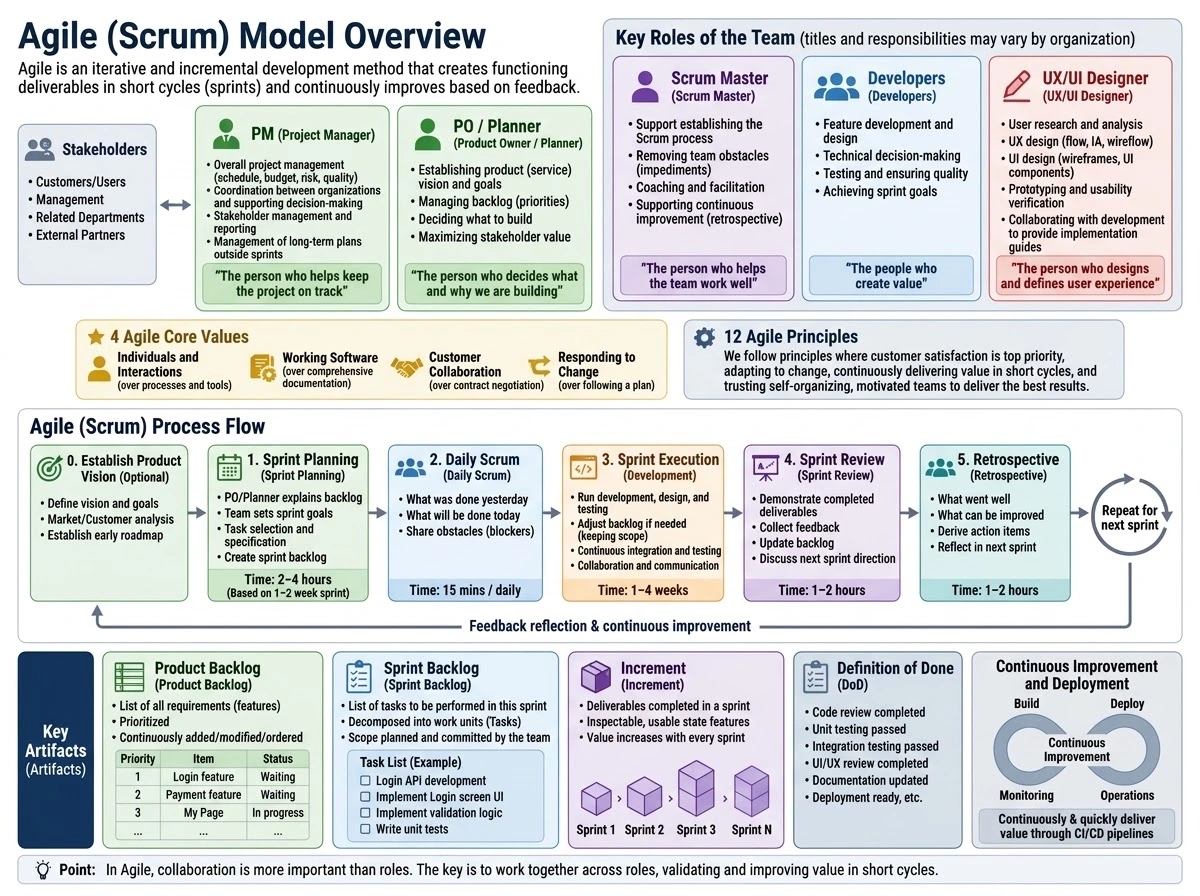
In the Agile model, there are roles called PM and PO instead of planners, and PMs, developers, and designers participate in the planning process together. Additionally, because deliverables are produced quickly and feedback is received, documentation is streamlined. Since things are not strictly fixed, it requires a large number of highly skilled individuals.
merit
I am resilient to change. I can adjust the tasks of each sprint according to priority.
You can quickly incorporate user feedback.
The team's autonomy and sense of responsibility increase.
disadvantage
It is easy to hear comments like, "We said we were doing Agile, but it feels like we're just working overtime." If implemented incorrectly, it leads to unplanned development. (There is a high probability that it will increasingly resemble the waterfall model being called Agile. The organizational culture must support it. Of course, I am not saying that adopting a hybrid approach of Agile and the waterfall model is bad.)
It is difficult to schedule the entire itinerary and costs in advance.
Teams lacking seniors don't function well, and self-direction is a prerequisite. (Actually, if you lack skill, it's hard to even take initiative... T_T)
Documentation tends to become sparse, and pain sets in at the time of handover.
3. Differences between Agile and Waterfall
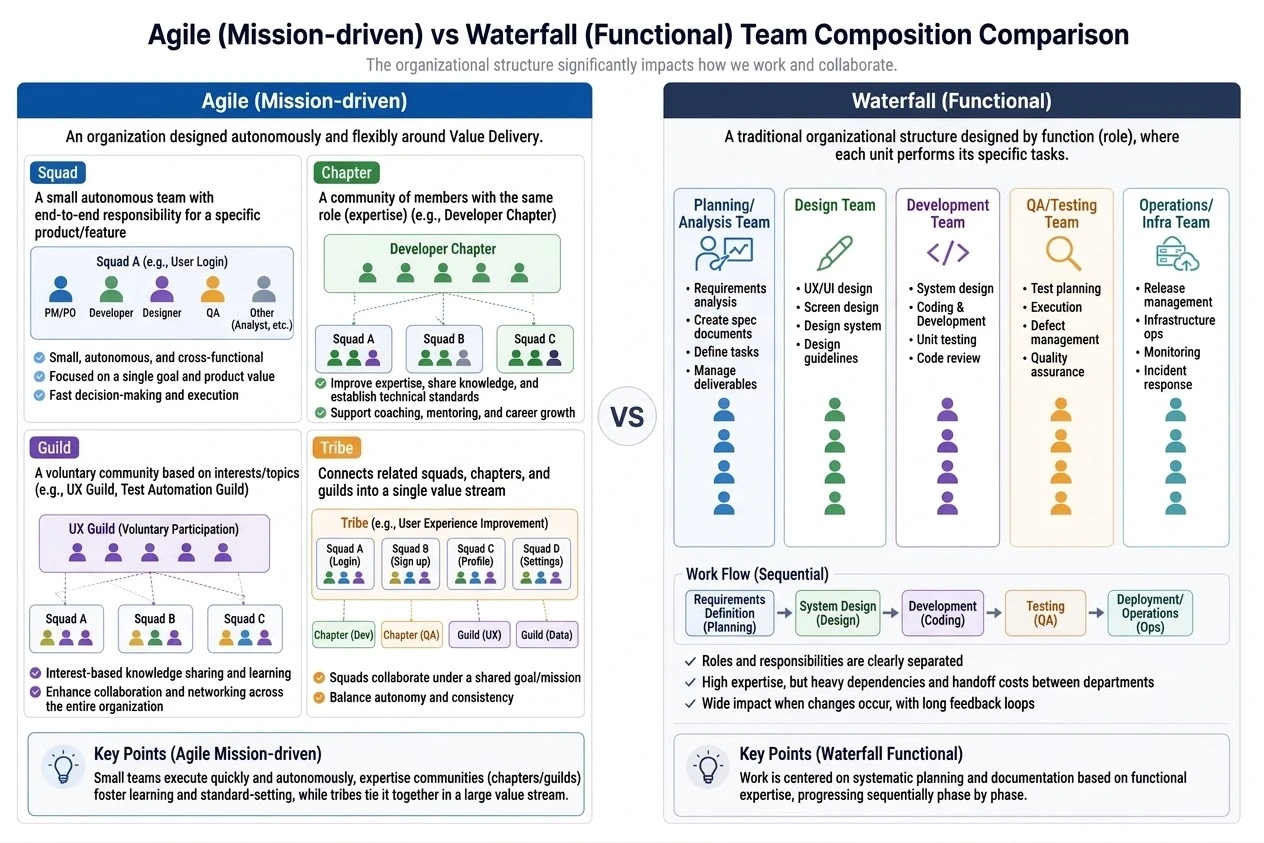
When the methodology changes, it is not simply the process that changes, but Roles, developer responsibilities, and even collaboration methods change together.
Agile deliverables | Waterfall Output Document (Screen Function Specification) |
|---|---|
 The above concept in a document like docs... Source: Wikidocs | 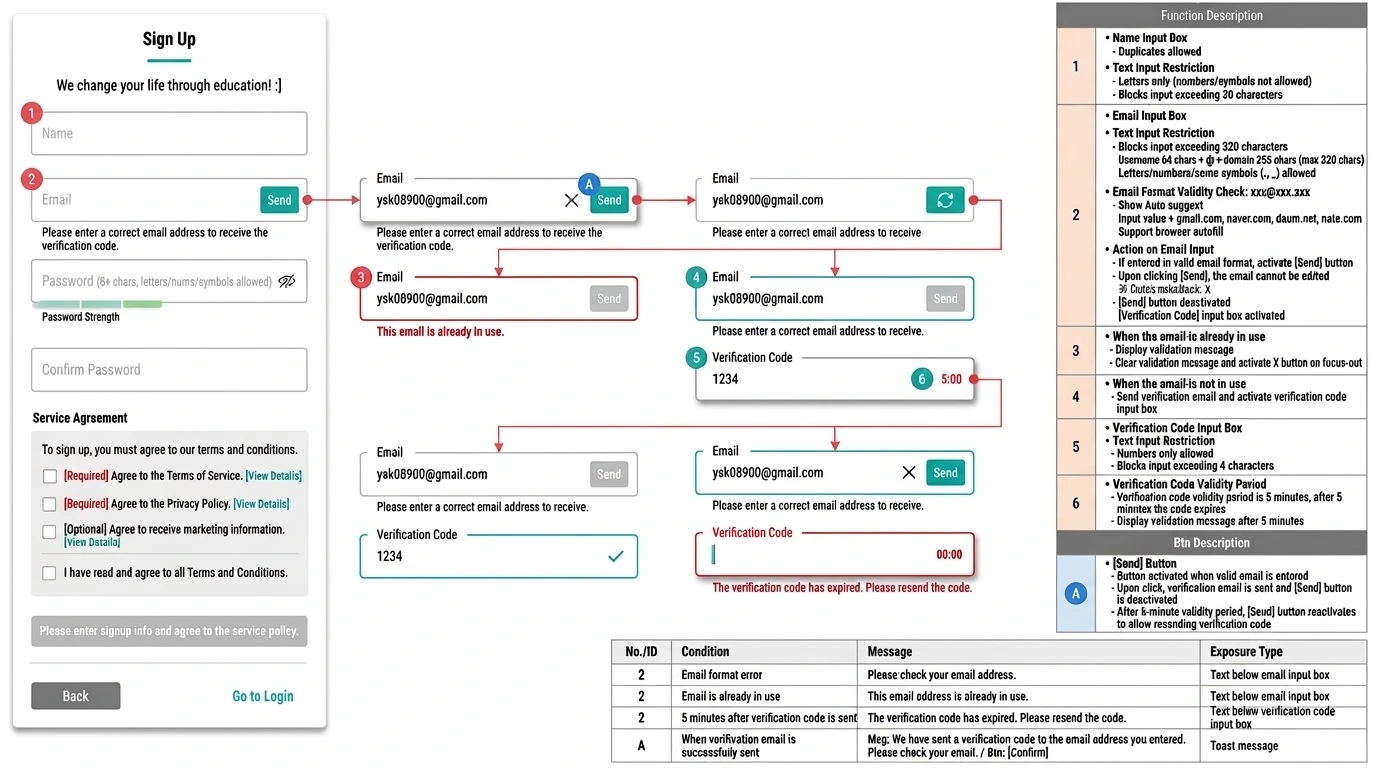 Source: Bacteriological Weapons Blog |
4. Concerns I had thought about
Q1. What if we go with a hybrid?
Waterfall for initial product development, followed by an Agile approach based on customer feedback in the operation phase
In a project, fixed functions where stability is important are handled via the Waterfall method, while functions intended to give the customer a "Wow" impression are handled via the Agile method.
Payment / Authentication / Settlement -> Waterfall
Recommendations / UI Improvements / Experimental Features -> Agile
For the methodology itself, use Waterfall for the planning phase and Agile for the feature/UX design and implementation phases.
Q2. What if I want to switch from Waterfall to Agile?
First of all, if a company attempts to switch from Waterfall to Agile, it will most likely fail. In my opinion, this is because both Waterfall and Agile methodologies directly reflect the organizational culture. Just by looking at the differences between Agile and Waterfall, you can see that the organizational structure itself is different.
If you simply add Scrum to an organization with a strong hierarchy and slow decision-making, it is nothing more than a company pretending to be Agile. In such a company, Scrum will become a venue for holding people accountable.
Before changing the methodology, change the delegation of authority and the decision-making structure (organizational culture) first!!!!!!!!!!!!!!!!!!!!!!!!
Q3. If you want to check whether our organization is closer to Agile or Waterfall?
It would be good to review the deliverable documents and processes. A representative document would be the screen feature specification. In the Waterfall method, since documentation is precise, a screen feature specification is created, and developers primarily refer to this document during development. However, in the Agile method, features are written in units of User Stories. Therefore, based on this document, Epics and tasks are generated for each User Story, and schedule estimation is also performed.
5. Conclusion
What I’ve been realizing lately is that to successfully create a good product, you must adopt a methodology that aligns with the project's characteristics and the organization's essence . Simply asserting, "I’m going to adopt this development methodology! This is how we’re going to proceed!" and executing it amounts to nothing more than forcing it into a process.
And I think the most important thing is team or company consensus on "why this methodology was chosen." No matter how well you explain it, it is useless if it only appeals to you personally. For example, even if the CEO doesn't want it at all, if the PM insists it is good, there is a very high probability that they will end up doing it this way if the CEO orders it... So, I believe that when selecting a single process, a project manager must incorporate their own thoughts, intentions, and reasons, and decide on the process that is best for the situation only after determining that those intentions can be achieved.
If thought, intention, and reason are missing from the decision on methodology, only the form will remain and become a shackle.
I hope the organization I am currently part of can also become a mature organization capable of continuously changing to suit the situation.