
Contents (6)
Improving the individual development process (Written with AI.)
After recently moving to a smaller company, I had the opportunity to collaborate with planners, designers, and backend developers on feature development for the first time in a while.
In the process, I realized that I was handling the work more inexperiencedly than I had thought.
In particular, during the feature development process, there were many cases where implementation began without sufficiently reviewing the user flow or API structure.
Looking back, I don't think I gave much thought to this aspect at the relatively large company I previously worked for.
Function definitions, screen specifications, and user flows were relatively systematically documented, and development often began after the flow had been verified together through several stages, albeit somewhat forcibly.
Therefore, even while developing the frontend, we often proceeded with implementation relying on the planning documents because the user flow was verified step-by-step in advance. (Despite the service planning being on a much larger scale, there were relatively fewer instances of illogical flow compared to my current company.)
At the time, thanks to that environment, work proceeded with verified flows following procedures, allowing us to develop without major issues. However, as we developed features in a small organization, we came to feel the need to verify the functional flow more actively.
So, as I frequently mentioned these issues to the designers and planners, I felt self-conscious and apologetic for appearing to be interfering. Anyway, in this post, I briefly explained how I proceeded with the work, what problems I encountered, and summarized how I plan to proceed in the future. (I haven't actually worked with the changed development process yet.)
Development Process (AS-IS)
Just one week after joining the company, I was immediately put in charge of developing the Credit feature .
The following three documents were referenced when starting development.
Credit Policy Document
Credit Screen Statement
Credit design screen
Based on these documents, we started development by understanding the user flow and providing feedback to the planner on UX-related issues that were strange or difficult to understand.
At the time, there didn't seem to be any major issues with the user flow. However, looking back now, there was one thing we missed.
It was a CS policy document.
At that time
"I see someone checking the business registration certificate and changing the status."
I just understood it to some extent and moved on. However, if I were to go back now, I would definitely have asked the question like this.
Is there a separate document regarding the process for changing the status after verifying the business registration certificate?
Discovery of the problem
The problem occurred during the process of connecting the backend API and organizing the business logic.
During this process, a critical flaw in the user flow was discovered. This flaw was a vulnerability that would make actual operation impossible if released as is, so it had to be fixed.
Eventually, the following happened.
Modify user flow
Planning document revision
Check design impact
Modify development code
In other words, the entire process had to be re-examined while development was already underway.
As a result, the entire team incurred additional costs, and the frontend team, in particular, bore the greatest burden of communication costs.
Due to the nature of the frontend
Planner
designer
Backend
This is because I have to communicate with everyone.
To summarize, the process at the time was as follows.
Planning → Design → Development → Problems found during development → Complete revision
In this structure , defects in user flows discovered late are propagated at the cost of the entire team.

Development Process (TO-BE)
After this experience, I was personally hurt in my pride because I was unable to finish the work within the targeted schedule.
So, I thought the problem was not a lack of development ability but a process issue, and I reorganized the steps I needed to take before starting development.
The improvement process I have outlined is as follows.
Planning Verification → Design Confirmation → Development
The key is to thoroughly verify the user flow before development .
By doing this, user flow issues can be resolved during the conversation phase with the planner.
in other words,
designer
Backend
Development code
It does not spread the influence up to.
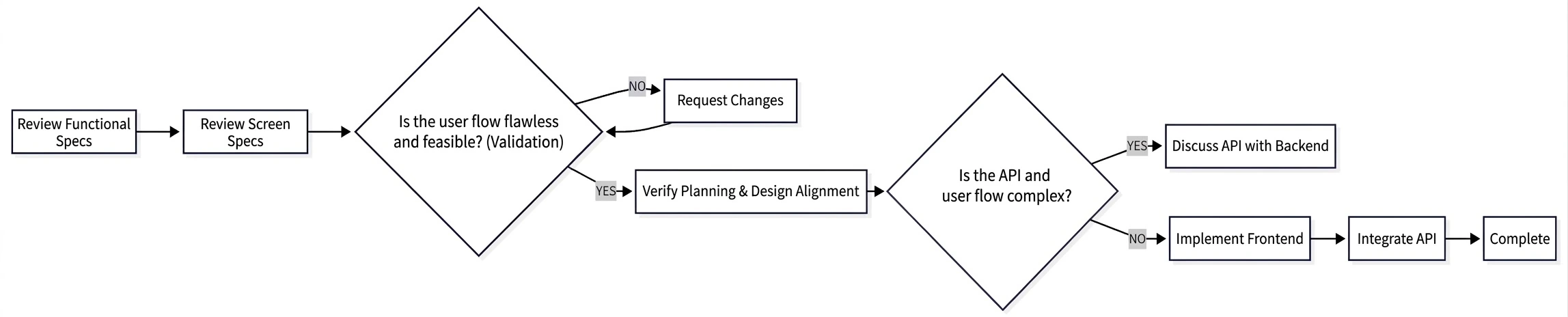
The advantages of this process that I thought of
The biggest advantage of this method is that it can minimize the scope of the problem's impact .
When a problem occurs
Planning Phase → Planner and Solution
Design Phase → Solve with the Designer
Development Phase → Code Modification
You can isolate problems step by step like this.
I consider this to be the process of moving away from the Single Point of Failure of the frontend in AS-IS.
I felt that even a slight improvement in the frontend process could significantly reduce communication costs for the entire team.
conclusion
There was only one thing I felt while collaborating a lot so far.
No matter how talented a planner, designer, or developer may be
There is no such thing as producing a 100% perfect result from the start. There is a 100% chance of making an error.
In fact, even successful services often experience this problem.
Naver Pay service outage lasting several hours
Toss Securities' Yen plunge bug
User backlash due to KakaoTalk's flawed planning
Ultimately, what matters is not who doesn't make mistakes, but
How quickly does it have a structure to detect and improve problems?
I think so.
So in the team, always
Discover the problem
Improve the process and
Trying to change it for the better
I felt that culture was needed.
Also, since the company I work for is a relatively small organization, it is closer to a structure where each person takes significant responsibility for one area.
So to speak, situations frequently occur where they act like a kind of one-man army .
Therefore, problems that one person fails to discover are likely to be passed on to the next step, whereas conversely, if one person successfully identifies a problem, the entire process can be significantly improved.
In this environment, I felt that not only individual development skills but also the ability to identify problems and ask questions , as well as an attitude to improve processes, were even more important.